



Your String Dampener Isn't Doing What You Think (Lab Data)

Your String Dampener Isn't Doing What You Think (Lab Data)
That little rubber dampener mostly changes the sound. The buzz that reaches your hand comes from the frame. A University of Minnesota team measured it on 19 college players hitting until they were spent. Less frame vibration meant fresher wrist muscles and more balls on target late in the session.
Based on Yeh et al., 2019, Sports Medicine and Health Science. Takeaways for rec players are ours.
SEE THE NUMBERSThe short version
A damping layer in the frame cut measured racket vibration by 34–40% during play.
With the standard racket, wrist extensors showed fatigue. With the damped one, they didn't.
Near exhaustion: 25% of forehands on target vs 17.6%. Ball speed didn't change.
Squeezing harder sends more vibration into the arm. That part you control today.
Why racket vibration is worth caring about
When the ball leaves the strings, the frame keeps ringing for a fraction of a second. That ringing travels down the handle into your hand and forearm. Right after impact, your wrist extensors (the muscles on the back of the forearm) fire hardest of all the arm muscles to hold the racket steady.
Most of us only notice it on a mishit, the jarring "thunk" off the frame. But it happens on every shot, a few hundred times a session. The question the researchers asked was simple: if you take some of that vibration away, does the arm tire more slowly, and does your tennis hold up better when you're tired?
Short answer: the racket vibrated less, the wrist showed less fatigue, and tired players hit the target more often. With some honest caveats, covered below.
How the study worked
Nineteen Division 1 players from the University of Minnesota hit serves and forehands against a ball machine until they rated their effort at 18 out of 20 ("very hard" to "extremely hard"). That took about 30 minutes. They did it twice, on separate days, with a different racket each time.
The two rackets were twins: same weight (319 g), same balance, same stiffness, same 98 sq in head, same strings at the same tension. The only difference was a thin vibration-damping composite layer built into one frame. Players didn't know which was which.
Sensors on the racket, hand and forearm recorded the vibration. Muscle sensors tracked five arm muscles. A radar tracked ball speed and where every ball landed relative to a 2 m × 2 m target.

What changed with the damped racket
Damped racket compared with the standard twin. Solid bars were statistically significant; striped bars were trends the study couldn't confirm.
The +40% on target is a relative figure, worked out from the 25% vs 17.6% hit rates in pooled data. The paper doesn't report a significance test for it, so we show it as a trend.
The finding that matters most: your wrist extensors
The researchers tested each player's muscles with a maximum-effort contraction before and after the session, looking at a signal shift that indicates muscle fatigue.
With the standard racket, the wrist extensors showed clear signs of fatigue. With the damped racket, they didn't. In fact all but one player showed a bigger fatigue drop on the standard racket. The biceps told the same story. The authors' wording is unusually firm for a study like this: the biceps and wrist extensors "did not fatigue" on the damped racket, while signs of fatigue appeared when the same players used the standard one.
Why care? The wrist extensors position the racket face for the incoming ball. When they tire, the face wanders, and so does your ball. That fits the accuracy result: late in the session, players on the damped racket kept placing more balls in the box.
The arm soaks up most of it anyway. Peak shock at the hand was roughly half of what the racket felt, and at the forearm about 5%. Your soft tissue is a shock absorber. The open question is how much work it has to do, shot after shot.

What about the little rubber dampener on your strings?
It mostly changes the sound. The paper sums up earlier research: string dampeners quiet the high-pitched string "ping" (above about 200 Hz), but the frame vibration that travels into your hand sits lower, around 80–200 Hz. Earlier studies found no good evidence that dampeners reduce vibration at the wrist or elbow.
Keep it if you like the sound. Just don't count on it to save your arm.
The variable nobody controlled: how hard you squeeze
Here's the most useful detail for rec players, and it's buried in the discussion. Vibration at the hand varied hugely from player to player, so the 20–25% drop at the hand couldn't be confirmed statistically. The authors' main suspect: grip force.
They cite earlier research showing that a tighter grip sends more vibration into the arm. They deliberately let players grip however they wanted, because telling them how hard to squeeze would have changed how they played.
The flip side: you can't retrofit a damping layer into the frame you already own. But how hard you squeeze, and what sits between your hand and the handle, is up to you.

Four things to try this week
None of these come from the study's protocol. They're our practical read of it for club players.
Between points, hold the handle at about 3 out of 10. Let it firm up naturally at contact. If your knuckles are white during the ready position, you're paying for it later.
The paper notes that where the ball hits the string bed changes how much vibration reaches you. Off-centre hits ring the frame harder. Clean contact is free damping.
Fatigue costs placement before it costs pace. End sessions with 20 target balls into one service box and count them. Track the number week to week.
A thin overgrip on a hard handle gives you little cushion and plenty of reasons to squeeze. That's the layer we build for.
More on grip pressure: You're gripping your racket twice as tight as you should be.

Play padel or pickleball? Here's what carries over
To be clear, this study only tested tennis rackets. Nobody wired up a padel or pickleball player. So treat the exact percentages as tennis numbers.
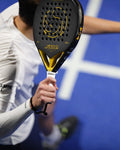
The basic physics still applies. A ball hits a stiff frame or face, the frame rings, and your hand and forearm hold it steady. Padel rackets and pickleball paddles have no strings, so a string dampener isn't even an option. The handle is where you meet the impact.
The habits carry straight over: a relaxed hand between shots, clean contact, and a handle that doesn't make you squeeze.
Read it with these caveats
19 college players averaging 21 years old. Usable sensor data came from 16. Rec players in their 40s and 50s weren't tested.
The racket maker funded the study and supplied both rackets. The authors state the company didn't influence the outcome.
Vibration at the hand and the extra forehands didn't reach statistical significance. Forearm vibration didn't differ.
The authors say plainly that the link between frame vibration and overuse injuries like tennis elbow is largely unproven.
The layer between your hand and the handle
The study damped vibration inside the frame. The Octopus Undergrip works one layer out, between the handle and your overgrip. It's a silicone layer with an octopus-style bump texture, designed to absorb vibration and give you a secure hold without a death grip.
To be straight with you: this study didn't test undergrips, and we're not claiming the Octopus reproduces its numbers. What it does is put cushioning where your hand meets the impact, and help you keep the relaxed hand we just covered. Same idea for tennis, padel and pickleball, with a version for each.

Keeps the overgrip you like and adds a cushioned layer underneath it.
SHOP TENNIS →
For padel rackets: no strings, no dampener, so the handle is where you feel the hit.
SHOP PADEL →
For pickleball paddles. Goes under the grip you already use, for the same cushioned layer.
SHOP PICKLEBALL →Frequently asked questions
Does racket vibration cause arm fatigue?
A 2019 University of Minnesota study found that a racket with less frame vibration was linked to less wrist extensor and biceps fatigue after about 30 minutes of hard hitting. It's one study with 19 elite college players, so it's early evidence rather than a final answer.
Do string vibration dampeners actually work?
They change the sound. Research summarised in the study shows dampeners quiet string frequencies above roughly 200 Hz, but don't meaningfully reduce the lower 80–200 Hz frame vibration that travels to the wrist and elbow.
Does gripping the racket tighter increase vibration?
Earlier research cited by the authors links higher grip force to more vibration reaching the arm. They named grip force as the likely reason hand vibration varied so much between players.
Does less vibration mean I'll hit harder?
Not in this study. Ball speed was the same with both rackets. The difference showed up in accuracy once players were tired: 25% of forehands on target with the damped racket vs 17.6% with the standard one.
Does this apply to padel and pickleball?
The study only tested tennis rackets. The underlying idea, a ball hitting a stiff frame and your forearm stabilising it, applies to all three, but the exact numbers haven't been measured for padel or pickleball.
Will a vibration-damping racket or undergrip prevent tennis elbow?
No product can promise that, and the study authors say the vibration-injury link is largely unproven. If your elbow or wrist hurts when you play, see a qualified professional.
Less buzz. Fresher wrist. More balls in.
You can't rebuild your frame. You can loosen your hand, find the sweet spot, and change what sits under your overgrip.
Pick the Octopus for your sport and try it through a month of sessions.
CHOOSE YOUR OCTOPUS →- Tennis · Padel · Pickleball
- 60-day money-back guarantee
Source: Yeh I-L, Elangovan N, Feczer R, Khosravani S, Mahnan A, Konczak J. "Vibration-Damping technology in tennis racquets: Effects on vibration transfer to the arm, muscle fatigue and tennis performance." Sports Medicine and Health Science 1 (2019) 49–58. doi:10.1016/j.smhs.2019.09.001. Open access, CC BY-NC-ND 4.0. RocketGrip is not affiliated with the authors, the University of Minnesota or the racket manufacturer, and no endorsement is implied. The study did not test RocketGrip products. The practical tips and product notes are ours. Images are illustrations. This article is general information, not medical advice.