


Relaxed Wrist or Firm Wrist on the Forehand? Both, in the Right Order

Relaxed Wrist or Firm Wrist on the Forehand? Both, in the Right Order
A loose wrist is what produces topspin and effortless power. A loose wrist at the wrong moment is what sprays the ball long. Here is where each one belongs in the swing.
SHOP NOWRocketGrip Equipment Desk · Based on Coach Simon Konov’s cues · 9 min read
Key takeaways
Loose through the swing, firm at contact. Not a compromise between the two — a sequence.
Hand on the throat during prep lets the hitting hand stay genuinely loose.
You can’t force it without stiffening the arm — which defeats the point.
Let it travel from laid back to neutral on its own as the forearm pronates.
Two answers that sound contradictory — and are both right
Ask ten coaches about the wrist on the forehand and you’ll hear two things. Relax it — that’s where the topspin and the easy power come from. And: keep it firm — a floppy wrist at contact is why the ball sails.
They describe different moments in the same swing, and club players struggle because nobody tells them which moment is which. Stiff from start to finish means muscling the ball: one or two clean, then exhaustion over three sets, with the wrist, elbow and shoulder carrying load they weren’t meant to. Loose at contact means snapping at the ball — no direction, and no real topspin for it either.
What follows is the sequence: where the relaxation lives, where the firmness appears, and the one part of the setup that makes it all possible.
1. The two failure modes, not one
Most advice picks a side. It’s more useful to know there are two distinct ways to get this wrong — and they produce completely different misses.
Tension through the whole swing. A couple of good shots early, then fatigue — and load building in the wrist, elbow and shoulder.
The wrist gives way exactly when the ball is on the strings. Control disappears, and the topspin doesn’t arrive either.
Coach Simon’s analogy: throw a punch stiff and locked and it looks violent but carries little. Throw it relaxed while the body rotates and there’s real power behind it. Loose hands and wrist, hard-working body.
Relaxed through the swing. Firm — not tightened — at the moment of contact.


2. Your other hand does the holding
This is the part that gets skipped — and, as Coach Simon puts it, the one that sets you up for the entire swing.
During preparation, the non-hitting hand should be holding the throat of the racket or the top of the grip. Not hovering nearby for balance. Actually holding it.
The racket head then sits higher than the grip, and the wrist ends up slightly cocked back — not because your forearm forces it there, but because the other hand carries the weight. A wrist held back by muscle is a tight wrist wearing the costume of a good position.
In prep there should be no tension in the hitting wrist at all — while the racket still sits exactly where you want it. A good position arrived at by relaxation, not by holding a shape.
3. Keep the racket head above the grip
Once the hands separate and you reach the power position, the same principle carries over — now as simple leverage.
Wrist and forearm have to hold it up. They have no choice but to tighten.
The weight is no longer hanging off your wrist, so the arm can relax.
Same swing, same effort, completely different tension — decided by where the racket head points. Shadow-swing both versions once to feel how obvious the difference is.
4. Racket lag is a symptom, not a move
You coil in the preparation and uncoil toward contact, using ground force as you go. The arm is carried along by that rotation rather than starting it.
Lag is the racket head trailing the hand — just before contact it looks as though the butt of the racket will meet the ball first. Every good forehand passes through it.
The trap: because lag is so visible in slow motion, players try to make it. The only way to force that slot is to stiffen the arm and drag it there. The players you’re copying aren’t doing that. Their lag is the by-product of a relaxed wrist meeting body rotation.
The fix is almost never “lag harder”. It’s upstream: the preparation, the support from the other hand, and whether the wrist was ever relaxed enough to trail.

5. At contact, the wrist is laid back — by itself
When the ball meets the strings, your wrist is cocked back. This is the “firm wrist” the other half of the coaching world means — and it’s not something you clench into place. Relaxation and the swing laid it back; the arm and body hold it there.
Arm shape is preference: an extended arm like Federer’s takes the ball further in front, a bent elbow brings it closer. Either way the wrist stays laid back and contact happens out in front, with the whole body behind the racket head.
Firm is not the same as tight
A firm wrist holds its angle because the structure around it supports it. A tight wrist is clamped by forearm muscle. They look similar on video and feel nothing alike to play with.
6. After contact: pronate, and let the wrist return to neutral
On a topspin forehand the forearm pronates from contact: palm open to the sky, turning toward the left side of the court (for a right-hander), then down — carrying the racket head from below the ball to above it. That low-to-high path gives you spin and net clearance.
Useful comparison: on the serve, pronation happens before contact. On the forehand you supinate during lag and pronate at contact.
Meanwhile the wrist travels from laid back to neutral. Allow it. Don’t drive it. Snapping costs control and stresses the joint; holding it back through the finish feels blocked and loads the wrist for nothing.
Pronate early, right at contact. Windshield-wiper finish, low to high.
Stay on the ball longer. The wrist moves forward to neutral, but hold full pronation until the racket has travelled as far through as it can.
Snap the wrist through, or pin it cocked after contact.

The instruction only works if the handle stays put
Everything above asks one thing: let go. Easy on a practice court, surprisingly hard in a match. If the handle moves when you loosen, you stop loosening. The grip creeps, the face isn’t where you left it, so you squeeze — the arm locks, the lag disappears, and the forearm aches by the third set.
That’s a hardware problem under a technique problem. The Octopus Undergrip is a textured silicone base layer that goes under your normal overgrip — designed to hold the handle in position in a relaxed hand and absorb some of the impact reaching the palm.
How to actually practise this
In the order that builds on itself. Don’t start at step four.
Other hand on the throat, head above the grip. The hitting hand should feel like it’s doing nothing.
Ten swings racket level, ten with the head above the grip. Notice where the forearm tightens.
Around 60%, one instruction: stay loose. Ignore depth and pace.
One question: does the racket head trail your hand before contact — without you trying?
Windshield wiper, wrist back to neutral on its own. Then ten flatter drives with later pronation.
Tight by the end? Something upstream is still asking your hand to do a job it shouldn’t.
Frequently asked questions
Should my wrist be loose or firm on the forehand?
Both, at different moments. Relaxed through preparation and the forward swing, which allows lag and effortless power. At contact it’s firm and laid back — but that firmness comes from the arm and body supporting it, not from clenching the forearm.
Why can’t I get racket lag on my forehand?
Usually because the arm is too tense to let the racket trail. Lag comes from a relaxed wrist meeting body rotation, not from pulling the racket into position. Forcing the shape requires stiffness, which removes the thing that creates it. Fix preparation and relaxation first.
Should I snap my wrist for more topspin?
No. Topspin comes from the low-to-high path and forearm pronation after contact. The wrist does travel from laid back to neutral, but on its own. Driving it there costs control and stresses the joint.
What does the non-hitting hand do on the forehand?
It holds the throat or the top of the grip during preparation. Carrying the racket’s weight with the other hand lets the hitting hand stay relaxed while the head sits above the grip and the wrist cocks back naturally.
Why does my forearm hurt after playing?
A common contributor is swinging tight — muscling the ball instead of letting rotation do the work, so the forearm works all match long. Persistent pain belongs with a doctor or physiotherapist, not a technique article.
Can my grip affect how relaxed I can hold the racket?
It affects how comfortable you are letting go. If the handle shifts in a loose hand, most players squeeze to keep the face predictable — the opposite of what the stroke needs. A base layer designed to hold the handle in position removes one reason to grip harder. It doesn’t replace technique; it stops working against it.
Watch the full breakdown
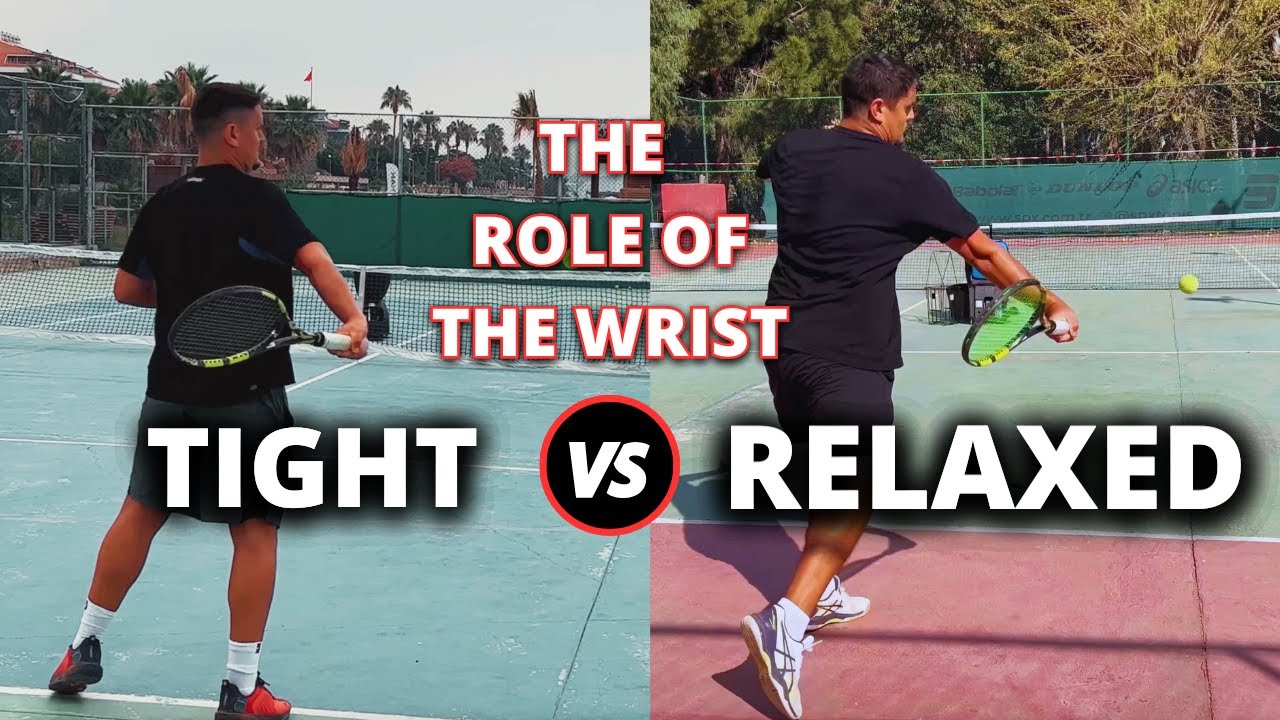
Ten minutes with Coach Simon Konov of Top Tennis Training. Not loading? Watch on YouTube.
Sore elbow? It often starts with a squeeze you don’t notice.
Coach Simon’s warning is plain: stay tight through the swing and over a match you risk the wrist, the elbow or the shoulder. For most club players the tightness isn’t a choice. It’s a loop.
You loosen up as coached — and the grip creeps in your hand.
To keep the face honest, the hand clamps. Every shot, without thinking.
No lag, no easy power — so you muscle the ball harder to compensate.
A tight arm takes more shock per hit. It tires, grips harder — back to step 1.
Break it at step 1
Technique retrains the swing. The Octopus Undergrip takes away the reason to squeeze. Its textured silicone layer sits under your overgrip, designed to keep the handle where you put it in a relaxed hand — and to damp some of the impact before it reaches your palm.
Fits any racket. On in about five minutes. You’ll feel the difference inside one basket of balls.
A grip accessory, not a medical device. Persistent elbow pain should be seen by a doctor or physio.

Source: coaching points from Coach Simon Konov’s Top Tennis Training video Perfecting Your Forehand Technique — Relaxed Wrist vs Tight Wrist? (watch the original). Interpretation, drill progression and equipment commentary are ours. RocketGrip is not affiliated with Top Tennis Training or Coach Simon Konov. RocketGrip products are sports accessories designed to improve grip stability and absorb vibration; they are not medical devices and do not treat, prevent or cure any condition. Persistent pain in the wrist, elbow or shoulder should be assessed by a doctor or physiotherapist.